


China Policy
China's 15th Five-Year Plan: Key policy directions and emerging priorities
Read more


Karl: It is fine as a nutshell, though a bit narrow. I also do a lot with trade instruments, and with Chinese industrial policy, industry, and technological progress. It all fits together, because supply chains include trade as well.
Karl: One clear trend is that China keeps catching up in core technologies. In sectors where European industry is strong, China is now just as good, and sometimes more competitive. The government pursues this very deliberately, and you can see it in the new Five-Year Plan. It is not only about future technologies like quantum computing or fusion energy, but also about strengthening traditional sectors such as mechanical engineering, for example through the right use and scaling of AI.
What is interesting is how selective they are. China does not reach the market leaders in industrial robots, those are more in Japan. But now it looks like China is skipping straight to humanoid robots, where they will very likely be world leaders. They leave out the development steps we went through and aim straight for the next one, picking deliberately where there is still potential to catch up, and which areas they simply leave aside. Combustion engines are a well-known example, but there are more.
Karl: Above all, Chinese export controls. You saw it especially in April 2025, when seven rare earths and rare earth magnets were placed under export controls. Another package came in October, on pause for now until around November, because the US and China have a kind of ceasefire in the trade dispute.
The trend is a shift away from reactive, eye-for-an-eye politics toward something much more systemic: keeping control over entire value chains, or even entire industries, in China. And it is moving from raw materials further along the chain, into intermediate and processed materials. Batteries are a good example: no longer just raw materials like graphite, but the processed substances and the processing technologies, which also come from China.
Karl: Yes, and it is difficult. Building independent value chains is very expensive and demanding, whether for batteries or for rare earth magnets. Chinese export controls and EU rules such as the Foreign Subsidies Regulation and the Industrial Accelerator Act increasingly collide: the EU may require that intellectual property is transferred into the EU, while Chinese export controls say the opposite. So, tension keeps building up in this increasingly institutionalized de-risking.
It is difficult for policymakers too, because there are so many conflicting goals. You want to build the battery industry in Europe, but it does not quite work without Chinese raw materials and technologies, which you would actually prefer to do without.
Karl: The important thing is that it is planned strategically and prepared for in a targeted way. For Europe specifically, one point matters: it is increasingly not only about control over flows of goods, but also over information. Through these export controls, China collects a lot of data about companies' own supply chains, and ends up with much better visibility than EU regulators, who are still in the dark. So part of the task is to build up corresponding parallel rules and institutions.
Karl: Inside companies, the view on supply chains often does not go far beyond Tier 1, the direct suppliers. But the risks often sit only at Tier 2 or Tier 3. It comes down to very specific knowledge: which technologies these are, which raw materials are in them, for which countries dependencies exist, and what can happen there, whether political conflicts or export controls. That is where the devil is in the detail. And the challenge is to establish supply chain transparency across so many countries in the first place.
Karl: A truly comprehensive view. That is where we add value, because inside companies everyone sits in their silos. We think about everything the company does: what comes in, which is the supply chain; what happens then, the operational and production side, including how data and goods move between sites; and what goes out, the distribution side. In which countries are these activities concentrated, and which risks exist there.
It is also important to understand where you can realistically do something, and what you simply have to accept. That covers a wide angle: technologies, raw materials, but also legal aspects, cybersecurity, and the development of markets. So a certain all-rounder talent is needed, though we cover that well through our team.
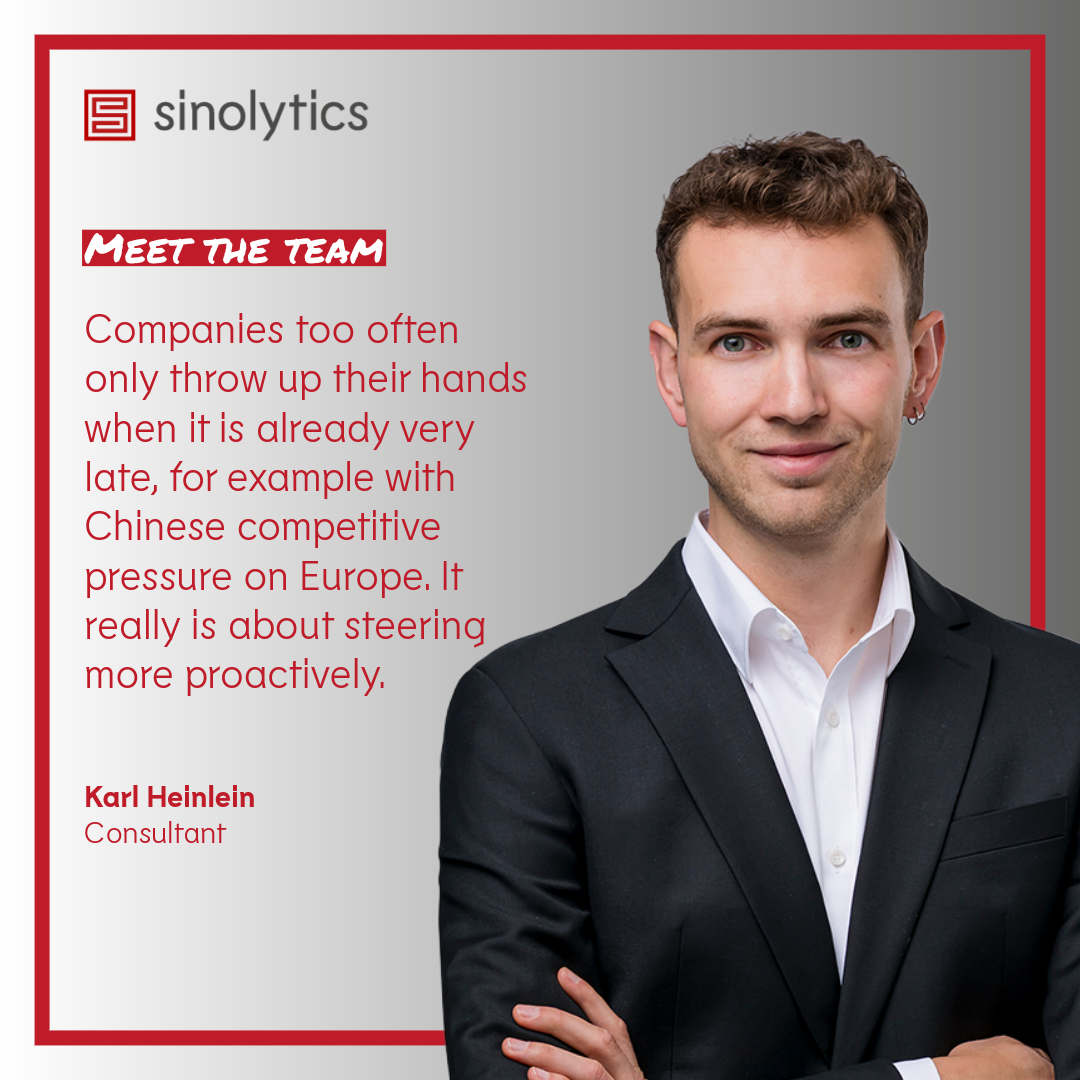
Karl: Companies too often only throw up their hands when it is already very late, for example with Chinese competitive pressure on Europe. It really is about steering more proactively, and you can see this becoming a bit more the case politically in the EU too.
It’s often misunderstood that export controls equal a full blockade. They don’t: they typically mean exports become subject to licensing, with approvals granted at the authorities’ discretion, leaving some room for companies and sometimes diplomatic channels to affect outcomes.
Karl: It definitely does something to me. In certain circles the tone is changing drastically, and a kind of war rhetoric has crept in. It does not yet refer to weapons, but you see it in the whole trade defense regime. The world of multilateralism we experienced for so many years, where you could talk to each other and work together, has to a large extent dissolved into nothing. That fills me with unease.
In my view is enormously important that there continues to be international exchange and understanding. In political discussions countries are talked about as if they were only power blocs, as if there were not the fates of people behind them. I think there is still a basis for mutual understanding, and for cooperation.

